
Corporate Tax vs Income Tax in India (2026): Complete Comparison Guide
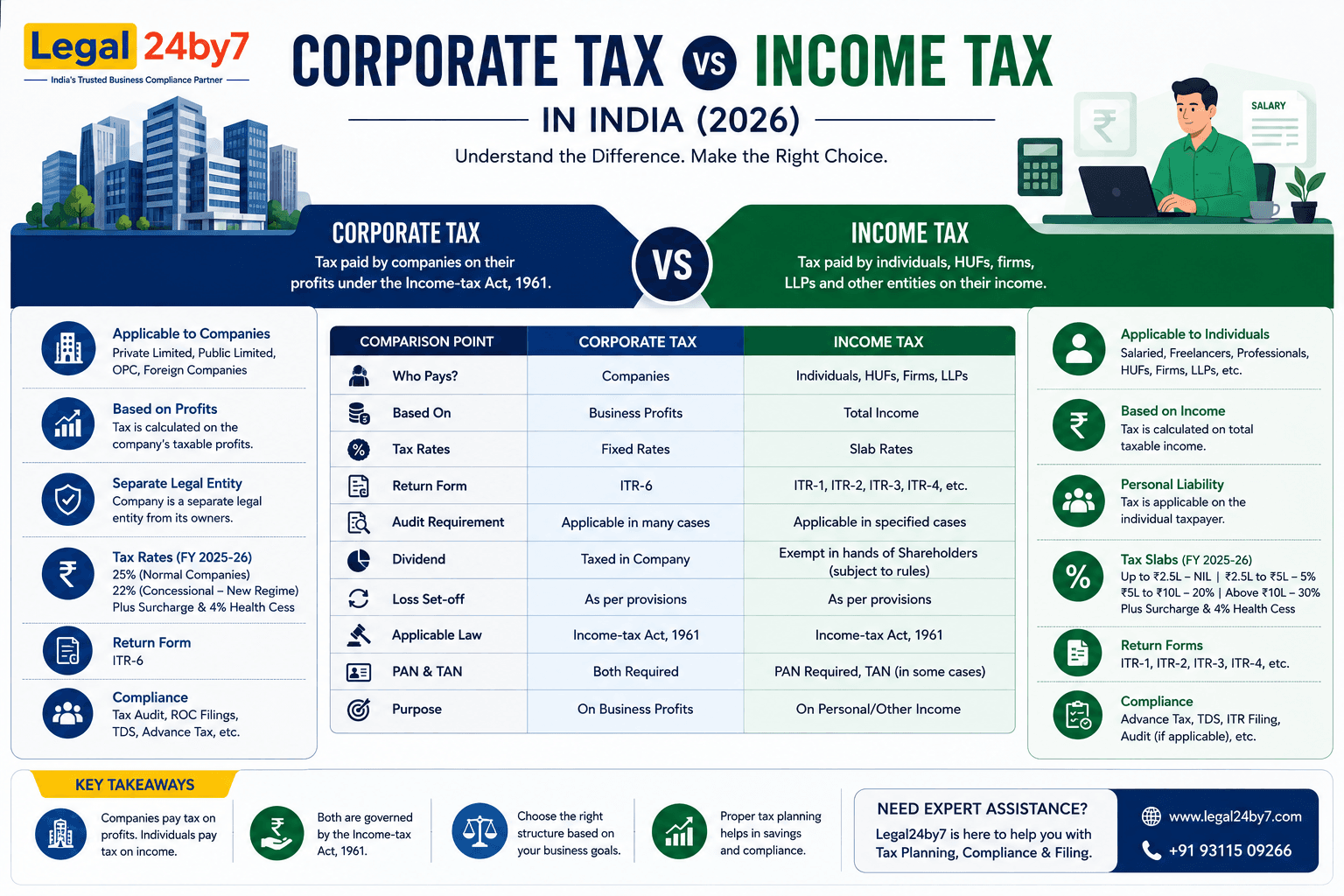
Corporate Tax vs Income Tax in India (2026): Complete Comparison Guide
Introduction
Taxes play a vital role in India's economy, funding public infrastructure, healthcare, education, and national development. However, many entrepreneurs, business owners, freelancers, and salaried individuals often confuse Corporate Tax with Income Tax.
Although both are forms of direct taxation, they apply to different taxpayers, follow different rules, and have distinct compliance requirements.
If you're starting a business, registering a company, or planning your taxes, understanding the difference is essential.
In this guide, we'll compare Corporate Tax and Income Tax in India using detailed tables, real-life examples, and practical insights.
What is Income Tax?
Income Tax is a direct tax imposed by the Government of India on the income earned by individuals and certain other taxpayers.
It applies to:
Salaried Employees
Freelancers
Professionals
Hindu Undivided Families (HUFs)
Partnership Firms
LLPs (taxed under separate provisions)
Other eligible taxpayers
The amount payable depends on taxable income and the applicable tax regime.
What is Corporate Tax?
Corporate Tax is the tax paid by companies on their profits.
It applies to:
Private Limited Companies
Public Limited Companies
One Person Companies (OPCs)
Foreign Companies (on taxable income in India, subject to applicable law and treaties)
Corporate tax is based on the company's taxable profits after allowable deductions and adjustments.
Corporate Tax vs Income Tax (Complete Comparison)
Particular | Corporate Tax | Income Tax |
|---|---|---|
Applicable To | Companies | Individuals & specified taxpayers |
Governing Law | Income-tax Act, 1961 | Income-tax Act, 1961 |
Taxpayer | Company | Individual |
Tax Basis | Company Profit | Individual Income |
PAN Required | Yes | Yes |
ITR Filing | Company ITR | Individual ITR |
Audit Requirement | Often applicable depending on legal requirements | Depends on applicable provisions |
Tax Slab | Company tax rates | Individual tax slabs |
Dividend | Subject to applicable tax provisions | Not Applicable |
Residential Status | Domestic / Foreign Company | Resident / Non-Resident Individual |
Quick Comparison
Feature | Corporate Tax | Income Tax |
|---|---|---|
Who Pays? | Companies | Individuals |
Based On | Business Profit | Personal Income |
Return Form | ITR-6 (commonly for companies, subject to eligibility) | Varies by taxpayer |
Government Authority | Income Tax Department | Income Tax Department |
Tax Collection | Annual | Annual |
Who Needs to Pay?
Taxpayer | Income Tax | Corporate Tax |
|---|---|---|
Salaried Employee | ✅ | ❌ |
Freelancer | ✅ | ❌ |
Consultant | ✅ | ❌ |
Sole Proprietor | ✅ | ❌ |
Partnership Firm | Taxed under applicable provisions | ❌ |
LLP | Taxed under applicable provisions | ❌ |
Private Limited Company | ❌ | ✅ |
Public Limited Company | ❌ | ✅ |
OPC | ❌ | ✅ |
Difference in Tax Calculation
Income Tax
Calculated on:
Salary
House Property
Capital Gains
Business Income
Other Sources
Less:
Eligible deductions
Exemptions (where applicable)
Standard deduction (subject to prevailing law)
Equals:
Taxable Income
Corporate Tax
Calculated on:
Business Revenue
Less:
Business Expenses
Depreciation
Eligible Deductions
Loss Set-off (subject to law)
Equals:
Taxable Profit
Tax Rate Comparison
Category | Income Tax | Corporate Tax |
|---|---|---|
Individual | Slab-based | Not Applicable |
Domestic Company | Not Applicable | Applicable corporate rate based on prevailing provisions |
Foreign Company | Not Applicable | Separate applicable rates |
Note: Tax rates, surcharge, cess, and eligibility for concessional rates can change through annual Finance Acts. Always refer to the latest provisions or consult a tax professional.
Compliance Comparison
Compliance | Individual | Company |
|---|---|---|
PAN | ✅ | ✅ |
TAN | Sometimes | Often Required |
Tax Audit | Applicable in specified cases | Applicable where required |
Advance Tax | Applicable | Applicable |
TDS | Applicable in specified situations | Applicable |
Books of Accounts | Depending on provisions | Mandatory under company law and tax law where applicable |
Due Date Comparison
Compliance | Individual | Company |
|---|---|---|
ITR Filing | As notified by the Income Tax Department | As notified by the Income Tax Department |
Advance Tax | Applicable | Applicable |
Tax Audit Report | If applicable | If applicable |
Advantages of Corporate Tax Structure
Benefit | Explanation |
|---|---|
Separate Legal Entity | Company and owners are legally distinct |
Limited Liability | Shareholders' liability is limited |
Business Continuity | Company continues despite ownership changes |
Better Funding Opportunities | Easier to attract investors |
Professional Image | Greater credibility |
Advantages of Individual Income Tax Structure
Benefit | Explanation |
|---|---|
Simple Compliance | Generally less complex than corporate compliance |
Lower Initial Cost | No incorporation required |
Easy Registration | Suitable for small businesses |
Direct Ownership | Owner retains full control |
Which One is Better?
Situation | Recommended |
|---|---|
Freelancer | Income Tax |
Salaried Employee | Income Tax |
Consultant | Income Tax or company structure depending on business needs |
Startup Seeking Investors | Company (Corporate Tax) |
Small Local Business | Depends on scale and objectives |
Large Business | Company |
Example
Example 1
Rahul works in an IT company and earns a salary.
He pays:
✅ Income Tax
❌ Corporate Tax
Example 2
ABC Technologies Private Limited earns profits from software development.
The company pays:
✅ Corporate Tax
The directors continue to pay Income Tax on their personal taxable income.
Common Myths
Myth | Reality |
|---|---|
Companies don't pay Income Tax | Companies pay tax under the corporate tax provisions of the Income-tax Act. |
Individuals pay Corporate Tax | Corporate tax applies to companies, not individuals. |
Corporate Tax and GST are the same | GST is an indirect tax; corporate tax is a direct tax. |
Every business should become a company | The right structure depends on business goals, compliance needs, and growth plans. |
Why Choose Legal24by7?
Whether you're an entrepreneur, startup founder, company director, or salaried professional, choosing the right tax structure is essential for long-term compliance and growth.
Legal24by7 offers:
Service | Available |
|---|---|
Income Tax Return Filing | ✅ |
Corporate Tax Advisory | ✅ |
Company Registration | ✅ |
LLP Registration | ✅ |
GST Registration | ✅ |
ROC Compliance | ✅ |
Accounting & Bookkeeping | ✅ |
Business Tax Planning | ✅ |
Frequently Asked Questions
Is Corporate Tax the same as Income Tax?
No. Corporate tax applies to companies, while income tax applies to individuals and certain other taxpayers.
Does a Private Limited Company pay Income Tax?
A company is taxed under the corporate tax provisions of the Income-tax Act.
Do company directors pay tax?
Yes. Directors pay income tax on their personal taxable income.
Can a freelancer pay Corporate Tax?
Not merely because they freelance. Corporate tax applies if business is carried through a company structure.
Which is better for startups?
Many startups choose a company structure due to limited liability and investment potential, but the right choice depends on individual circumstances.
Conclusion
Corporate Tax and Income Tax are both essential components of India's direct tax system, but they serve different taxpayers and business structures. Individuals are taxed on personal income, while companies are taxed on business profits. Understanding these distinctions helps you choose the right legal structure, stay compliant, and make informed financial decisions.
If you need assistance with company registration, tax planning, income tax filing, corporate tax compliance, or business advisory, Legal24by7 can provide end-to-end support tailored to your needs.
Get it done today
Legal24by7 Team
Legal expert at Legal24by7, helping Indian startups and MSMEs navigate compliance.

