
GST Annual Return (GSTR-9): Complete Guide for Businesses in India (2026)
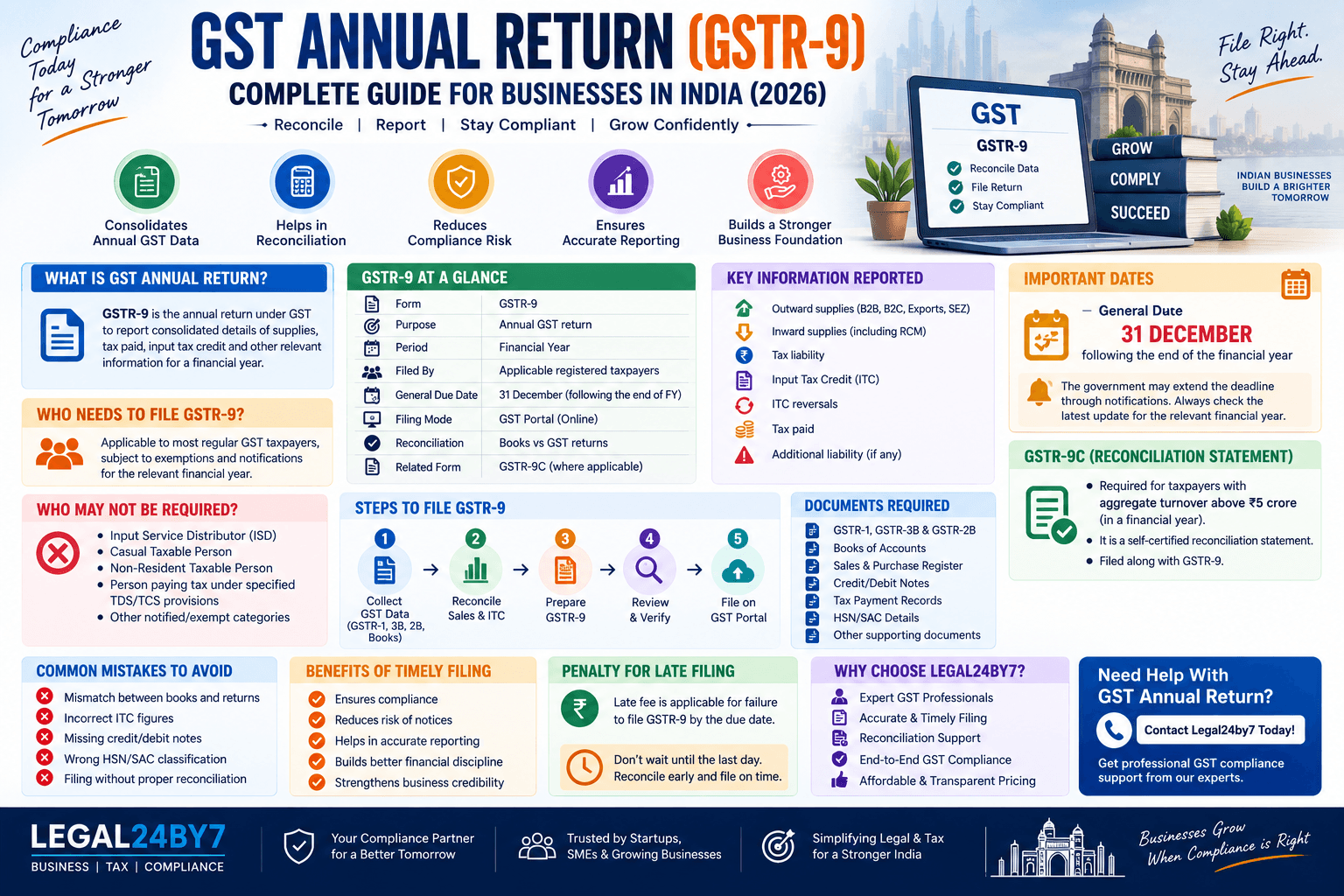
🧾 GST Annual Return (GSTR-9): Complete Guide for Businesses
🟦 Quick Answer
GSTR-9 is the annual GST return used to consolidate details of supplies, tax paid, input tax credit and other GST information for a financial year. The general statutory due date is 31 December following the end of the financial year, subject to applicable exemptions or extensions.
For businesses registered under GST, annual compliance is important because it provides an opportunity to reconcile the information reported during the year in periodic GST returns with the business's books and records.
📌 What is GST Annual Return?
A GST Annual Return is a consolidated statement of GST-related information for a particular financial year.
The principal annual-return form for regular taxpayers is GSTR-9.
It broadly captures information relating to:
🛒 Outward supplies
📦 Inward supplies
💰 Tax liability
💳 Input Tax Credit (ITC)
🔄 ITC reversals
💵 Tax paid
⚠️ Additional liability, where applicable
The prescribed GSTR-9 format includes details of outward and inward supplies, taxable value and tax components.
📊 GSTR-9 at a Glance
Particular | Details |
|---|---|
📄 Form | GSTR-9 |
🧾 Purpose | Annual GST return |
📅 Period | Financial Year |
🏢 Filed By | Applicable registered taxpayers |
📆 General Due Date | 31 December of following FY |
💻 Filing | GST Portal |
🔍 Reconciliation | Books vs GST returns |
📑 Related Form | GSTR-9C, where applicable |
👥 Who Needs to File GSTR-9?
The applicability of GSTR-9 depends on the taxpayer's category and the exemptions notified for the relevant financial year.
Section 44 of the CGST Act provides for annual returns by registered persons, subject to specified exclusions such as certain ISDs, persons paying tax under specified provisions, casual taxable persons and non-resident taxable persons.
🟨 Important
GST annual-return requirements can change through notifications for particular financial years. Therefore, businesses should check the rules applicable to the specific FY before filing.
🚫 Who May Not Be Required to File?
Certain categories are excluded from the normal GSTR-9 requirement under the GST framework, including:
Category | GSTR-9 |
|---|---|
Input Service Distributor | ❌ Generally excluded |
Casual Taxable Person | ❌ Generally excluded |
Non-Resident Taxable Person | ❌ Generally excluded |
Person paying tax under specified TDS/TCS provisions | ❌ Generally excluded |
Other notified/exempt categories | Depends on notification |
💰 GSTR-9 Turnover Applicability
One of the most common questions businesses ask is:
“Is GSTR-9 mandatory for every GST-registered business?”
Not necessarily.
The Government can notify exemptions for particular financial years.
Therefore, do not rely on a generic turnover limit without checking the notification applicable to the relevant financial year.
This is particularly important when preparing annual compliance for different financial years.
📑 What Information is Reported in GSTR-9?
1️⃣ Basic Details
This includes:
Financial Year
GSTIN
Legal Name
Trade Name
The prescribed GSTR-9 format begins with these basic details.
2️⃣ Outward & Inward Supplies
Supply Type | Examples |
|---|---|
B2B | Sales to registered businesses |
B2C | Sales to consumers |
Export | Export supplies |
SEZ | Supplies to SEZ |
Deemed Export | Eligible deemed exports |
Reverse Charge | Applicable inward supplies |
💳 Input Tax Credit (ITC)
GSTR-9 also requires reporting and reconciliation of ITC-related information.
Businesses should compare:
Purchase Register
⬇️
GSTR-2B / Available ITC
⬇️
GSTR-3B ITC Claimed
⬇️
GSTR-9 Reporting
This reconciliation can help identify discrepancies before the annual return is filed.
🔄 GST Annual Reconciliation
<div style="background:#E8F4FD;padding:18px;border-left:5px solid #0D6EFD;border-radius:8px;">
🔍 Before filing GSTR-9
Compare:
Books of Accounts ↔ GSTR-1 ↔ GSTR-3B ↔ GSTR-2B ↔ GSTR-9
Look for differences in:
✔ Sales
✔ Tax liability
✔ ITC
✔ Credit notes
✔ Debit notes
✔ Exempt supplies
✔ Reverse-charge transactions
</div>
📊 GST Annual Return Reconciliation Checklist
Area | Check |
|---|---|
Sales | Books vs GSTR-1 |
Tax Liability | GSTR-1 vs GSTR-3B |
ITC | Books vs GSTR-2B |
ITC Claimed | GSTR-3B vs Books |
Credit Notes | Books vs GST returns |
Debit Notes | Books vs GST returns |
RCM | Books vs returns |
Exports | Books vs GST returns |
HSN/SAC | Correct classification |
📅 GSTR-9 Due Date
Under Section 44, the general statutory due date for the annual return is:
31 December following the end of the financial year
For example:
Financial Year | General Statutory Due Date |
|---|---|
FY 2024–25 | 31 December 2025 |
FY 2025–26 | 31 December 2026 |
FY 2026–27 | 31 December 2027 |
The Government may extend deadlines through notifications or orders, so taxpayers should verify the applicable due date for the relevant year.
📋 Documents Required for GSTR-9
Keep the following information ready:
Document / Record | Purpose |
|---|---|
📊 GSTR-1 | Outward supply reconciliation |
🧾 GSTR-3B | Tax and ITC reconciliation |
💳 GSTR-2B | ITC verification |
📚 Books of Accounts | Financial reconciliation |
🧾 Sales Register | Revenue verification |
🛒 Purchase Register | ITC verification |
📑 Credit/Debit Notes | Adjustment verification |
🏦 Tax Payment Records | Tax reconciliation |
📦 HSN/SAC Details | Annual reporting |
🔎 What is GSTR-9C?
GSTR-9C is a reconciliation statement associated with the annual return for taxpayers meeting the applicable turnover threshold.
Under the current framework reflected in Rule 80, a registered person whose aggregate turnover exceeds ₹5 crore in a financial year is required to furnish a self-certified GSTR-9C along with GSTR-9, subject to the applicable rules.
GSTR-9 vs GSTR-9C
Feature | GSTR-9 | GSTR-9C |
|---|---|---|
Purpose | Annual GST Return | Reconciliation Statement |
Main Information | GST transactions & tax | Books vs GST reconciliation |
Applicable To | As prescribed | Above applicable turnover threshold |
Self-Certification | Applicable | ✅ |
Filed With | — | GSTR-9 |
🟧 Important: GSTR-9C is not simply another annual return. It is a reconciliation statement that accompanies GSTR-9 where applicable.
🛠️ GSTR-9 Filing Process
Step 1️⃣ — Collect GST Data
Download/compile:
GSTR-1 + GSTR-3B + GSTR-2B + Books
Step 2️⃣ — Reconcile Sales
Compare sales recorded in books with GST returns.
Step 3️⃣ — Reconcile ITC
Check ITC claimed against eligible ITC and supporting records.
Step 4️⃣ — Identify Differences
Review:
Missing invoices
Credit notes
Debit notes
RCM
ITC reversals
Amendments
Step 5️⃣ — Prepare GSTR-9
Enter the applicable annual figures.
Step 6️⃣ — Review
Check tax liability and ITC carefully before submission.
Step 7️⃣ — File
Submit the return electronically through the GST Portal.
The GSTN's filing utility directs taxpayers to Services → Returns → Annual Return on the GST Portal.
⚠️ Common GSTR-9 Mistakes
<div style="background:#FDECEC;padding:18px;border-left:5px solid #DC3545;border-radius:8px;">
❌ Filing without reconciling books
❌ Incorrect turnover
❌ Incorrect ITC figures
❌ Ignoring credit/debit notes
❌ Missing reverse-charge transactions
❌ Incorrect HSN/SAC information
❌ Not checking GSTR-2B
❌ Assuming GSTR-9 is automatically prepared correctly
❌ Missing the applicable filing deadline
</div>
💡 Why GST Annual Reconciliation Matters
A proper annual reconciliation can help businesses identify discrepancies between:
Books of Accounts
⬇️
GSTR-1
⬇️
GSTR-3B
⬇️
ITC Records
⬇️
GSTR-9
This makes the annual return more accurate and helps businesses identify potential additional tax liability or reporting errors.
💰 Late Filing of GSTR-9
Failure to furnish an annual return by the applicable due date can attract late fees under the GST law.
The CGST Act provides for a late fee for failure to furnish the annual return by the prescribed date.
🔴 Don't wait until the last day.
Annual reconciliation can take significantly longer when there are differences between books, invoices and GST returns.
📊 GSTR-9 Compliance Timeline
Stage | Recommended Action |
|---|---|
📅 April–June | Maintain accurate records |
📅 July–September | Reconcile GST data periodically |
📅 October–November | Start annual reconciliation |
📅 November–December | Prepare GSTR-9 / GSTR-9C, where applicable |
📅 31 December | General statutory deadline |
⭐ Benefits of Professional GSTR-9 Filing
Benefit | Advantage |
|---|---|
🔍 Reconciliation | Identifies discrepancies |
📊 Accurate Reporting | Reduces errors |
💳 ITC Review | Helps identify mismatches |
🧾 Documentation | Better compliance records |
⚠️ Risk Management | Helps identify potential issues |
⏰ Timely Filing | Avoids unnecessary delay |
❓ Frequently Asked Questions
What is GSTR-9?
GSTR-9 is the annual GST return used to consolidate GST-related information for a financial year.
Is GSTR-9 mandatory for every GST taxpayer?
No. Applicability depends on the taxpayer category and exemptions/notifications applicable to the relevant financial year.
What is the due date for GSTR-9?
The general statutory due date is 31 December following the end of the financial year, subject to extensions or specific notifications.
What is the difference between GSTR-9 and GSTR-9C?
GSTR-9 is the annual return. GSTR-9C is a reconciliation statement required for taxpayers crossing the applicable turnover threshold. Under the current Rule 80 framework, the threshold for GSTR-9C is more than ₹5 crore.
Can GSTR-9 be revised?
Taxpayers should exercise care before filing because the ability to revise an annual return is restricted. Therefore, reconcile the data thoroughly before final submission.
What records should I maintain?
Maintain sales and purchase records, GST returns, invoices, credit/debit notes, ITC records, tax-payment information and books of accounts.
⭐ Why Choose Legal24by7?
<div style="background:linear-gradient(90deg,#0D6EFD,#4F46E5);color:white;padding:22px;border-radius:10px;">
GST Compliance Support
✅ GST Annual Return Filing
✅ GSTR-9 Preparation
✅ GSTR-9C Assistance
✅ GST Reconciliation
✅ GSTR-1 & GSTR-3B Filing
✅ ITC Reconciliation
✅ GST Notice Reply
✅ GST Compliance Support
Keep your GST records accurate, reconciled and compliant.
</div>
📞 Need Help With GST Annual Return?
Don't wait until the deadline to discover differences in your GST records.
Legal24by7 can assist businesses with GST return filing, annual reconciliation and applicable GST compliance.
GST Annual Return Support by Legal24by7
GSTR-9 | GSTR-9C | GST Reconciliation | GST Compliance
Contact Legal24by7 today for professional GST compliance assistance.
Get it done today
Legal24by7 Team
Legal expert at Legal24by7, helping Indian startups and MSMEs navigate compliance.
