Section 8 Company Registration: Complete Guide to NGO Registration in India (2026)
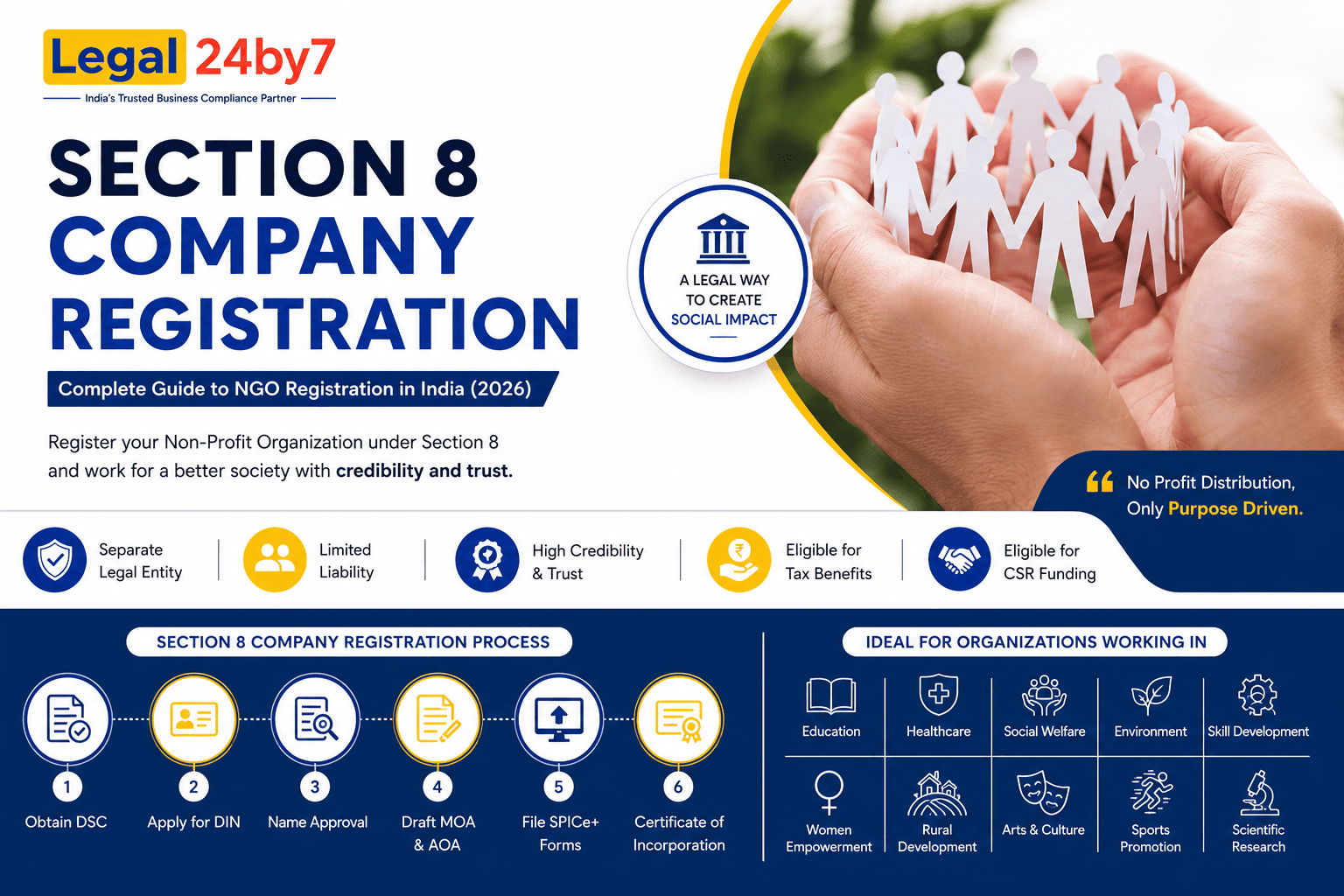
If you're planning to start a Non-Profit Organization (NPO) in India, Section 8 Company Registration is one of the most credible and legally recognized options. Whether your goal is to promote education, healthcare, environmental protection, social welfare, art, science, or charitable activities, a Section 8 Company provides a structured and transparent legal framework.
Unlike other business entities, a Section 8 Company is formed with the primary objective of promoting charitable causes rather than earning profits for its members. Any surplus income generated must be reinvested to achieve the company's objectives.
In this comprehensive guide, you'll learn everything about Section 8 Company Registration in India, including eligibility, benefits, required documents, registration process, compliance requirements, costs, and frequently asked questions.
What is a Section 8 Company?
A Section 8 Company is a company registered under the Companies Act, 2013 for promoting charitable or non-profit objectives.
The company may work for:
Education
Social Welfare
Healthcare
Environment Protection
Women Empowerment
Skill Development
Sports Promotion
Rural Development
Art & Culture
Scientific Research
Unlike private companies, profits cannot be distributed as dividends among members.
Key Features of a Section 8 Company
Feature | Details |
|---|---|
Legal Status | Registered under Companies Act, 2013 |
Purpose | Charitable & Non-Profit Activities |
Profit Distribution | Not Allowed |
Separate Legal Entity | ✅ Yes |
Limited Liability | ✅ Yes |
Perpetual Succession | ✅ Yes |
Eligible for Funding | ✅ Yes |
Government Recognition | High |
Who Should Register a Section 8 Company?
A Section 8 Company is suitable for:
Organization Type | Recommended |
|---|---|
NGOs | ✅ Yes |
Charitable Trusts | ✅ Yes |
Educational Institutions | ✅ Yes |
Healthcare Organizations | ✅ Yes |
Skill Development Centres | ✅ Yes |
Women Empowerment Groups | ✅ Yes |
Environmental Organizations | ✅ Yes |
CSR Implementation Agencies | ✅ Yes |
Benefits of Section 8 Company Registration
Benefit | Description |
|---|---|
Separate Legal Entity | Company has its own legal identity. |
Limited Liability | Members' liability is limited. |
Higher Credibility | Preferred by donors and government bodies. |
Tax Benefits | Eligible for various tax exemptions (subject to approval). |
Funding Opportunities | Easier to receive CSR funds and grants. |
Perpetual Succession | Continues despite changes in members. |
Better Governance | Governed by the Companies Act. |
National Recognition | Trusted structure for non-profit work. |
Eligibility Criteria
To register a Section 8 Company:
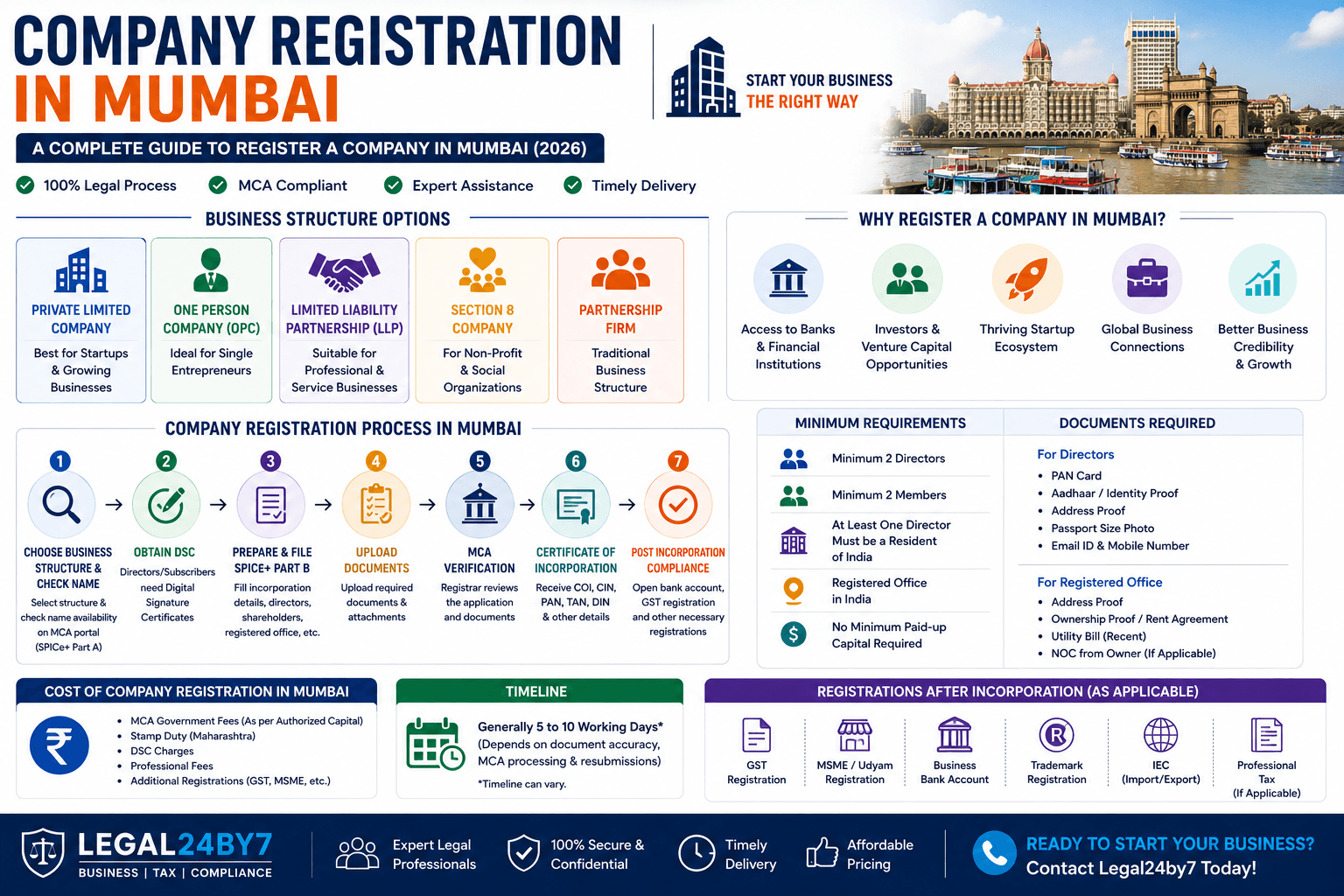
Minimum 2 Directors (Private)
Minimum 2 Members
At least 1 Resident Director
Valid Registered Office Address
Charitable or Non-Profit Objective
No Dividend Distribution
Documents Required
Documents of Directors
Document | Required |
|---|---|
PAN Card | ✅ |
Aadhaar Card | ✅ |
Passport Size Photograph | ✅ |
Mobile Number | ✅ |
Email Address | ✅ |
Registered Office Documents
Document | Required |
|---|---|
Electricity Bill | ✅ |
Rent Agreement (if rented) | Applicable |
No Objection Certificate (NOC) | Applicable |
Property Tax Receipt (if owned) | Applicable |
Registration Process
Step 1 – Obtain Digital Signature Certificate (DSC)
Every proposed director must obtain a Digital Signature Certificate.
Step 2 – Apply for Director Identification Number (DIN)
DIN is required for all directors.
Step 3 – Name Approval
Apply for company name approval through the MCA portal.
Step 4 – Prepare MOA & AOA
Draft the Memorandum of Association (MOA) and Articles of Association (AOA) reflecting the charitable objectives.
Step 5 – File SPICe+ Forms
Submit incorporation forms along with the required documents.
Step 6 – Certificate of Incorporation
After verification, the Registrar of Companies (ROC) issues the Certificate of Incorporation.
Comparison: Section 8 Company vs Trust vs Society
Feature | Section 8 Company | Trust | Society |
|---|---|---|---|
Governing Law | Companies Act | Trust Act | Societies Registration Act |
Separate Legal Entity | ✅ Yes | Limited | Limited |
Credibility | High | Moderate | Moderate |
CSR Funding | Highly Preferred | Limited | Limited |
Compliance | Moderate | Low | Moderate |
National Operations | Easy | Moderate | Moderate |
Transparency | High | Medium | Medium |
Annual Compliance Requirements
Every Section 8 Company must comply with statutory requirements.
Compliance | Frequency |
|---|---|
ROC Annual Filing | Every Year |
Board Meetings | As Required |
Financial Statements | Annual |
Income Tax Return | Annual |
Audit | Mandatory |
Statutory Registers | Maintain Regularly |
Tax Benefits
Subject to approval from the Income Tax Department, Section 8 Companies may apply for:
12A Registration
80G Registration
CSR Funding Eligibility
Government Grants
Foreign Funding (subject to FCRA registration)
Estimated Timeline
Activity | Estimated Time |
|---|---|
DSC & DIN | 1–2 Days |
Name Approval | 2–4 Days |
Document Preparation | 2–3 Days |
ROC Approval | 5–10 Working Days |
Total Time | Approximately 10–15 Working Days |
Why Choose a Section 8 Company?
Choose a Section 8 Company if you want:
Professional NGO structure
Better credibility
Easier CSR funding opportunities
Transparent governance
National-level recognition
Strong legal framework
Why Choose Legal24by7?
Legal24by7 simplifies the Section 8 Company registration process with expert legal and compliance support.
Our Services Include:
✅ Name Approval Assistance
✅ DSC & DIN Support
✅ Drafting MOA & AOA
✅ Complete ROC Filing
✅ PAN & TAN Assistance
✅ 12A & 80G Registration Support
✅ Annual Compliance Assistance
✅ Dedicated Compliance Experts
Frequently Asked Questions (FAQs)
1. What is a Section 8 Company?
A Section 8 Company is a non-profit company registered under the Companies Act, 2013 to promote charitable objectives.
2. Can a Section 8 Company earn profits?
Yes, but the profits must be used to further the company's objectives and cannot be distributed as dividends.
3. How many directors are required?
A minimum of 2 directors is required for a private Section 8 Company.
4. Is audit mandatory?
Yes. Every Section 8 Company must maintain proper books of accounts and undergo an audit as required by law.
5. Can a Section 8 Company receive donations?
Yes. It can receive donations, grants, and CSR funding, subject to applicable laws and approvals.
6. Is GST registration compulsory?
GST registration depends on the nature of activities and turnover, as per applicable GST laws.
7. Can foreign citizens become directors?
Yes, subject to the provisions of the Companies Act and other applicable regulations.
8. Can a Section 8 Company own property?
Yes. It can acquire, own, and manage property in its own name.
9. What is the difference between a Trust and a Section 8 Company?
A Section 8 Company generally offers stronger governance, higher credibility, and a more structured compliance framework than a Trust.
10. How long does registration take?
Typically 10–15 working days, depending on document readiness and government processing times.
Conclusion
A Section 8 Company is one of the most trusted legal structures for organizations committed to social impact and charitable work. Its transparent governance, limited liability, and strong legal recognition make it an ideal choice for NGOs, educational institutions, healthcare organizations, and CSR implementation agencies.
If you're looking to register a Section 8 Company, Legal24by7 offers end-to-end assistance—from name approval and incorporation to tax registrations and ongoing compliance—helping you focus on creating meaningful impact while we handle the legal formalities.
Ready to start your NGO or non-profit organization? Contact Legal24by7 today for expert guidance on Section 8 Company Registration and compliance.
Get it done today
Legal24by7 Team
Legal expert at Legal24by7, helping Indian startups and MSMEs navigate compliance.